What a visit actually involves
Two very different visits
Most people come to Hohensalzburg for the daytime walk through the state rooms and ramparts. Separately, Viator lists a dinner-and-concert evening held inside the fortress's historic halls after hours, built around Mozart's music — a different product entirely, and the main one on the Viator listing this site links to.
Begun in 1077, still standing
Archbishop Gebhard von Helfenstein started the fortress in 1077 as a basic bailey with a wooden wall, during the Investiture Controversy between the papacy and the Holy Roman Emperor. Much of the late-Gothic core came later, under Leonhard von Keutschach (1495–1519), who fitted out the state rooms from 1498.
A minute up, or thirty on foot
The Festungsbahn funicular has carried visitors up from Festungsgasse since 1892 — on water ballast until 1959, electric since 1960 — and the ride takes under a minute. The footpath climbs the same hill in about thirty minutes on steep cobbles and steps, for anyone who'd rather walk.
Never taken by force
The fortress held out against a siege during the German Peasants' War of 1525 — the only siege it has faced — and in 1800 it was handed to French forces without a fight, a surrender rather than a military defeat.
What's actually inside
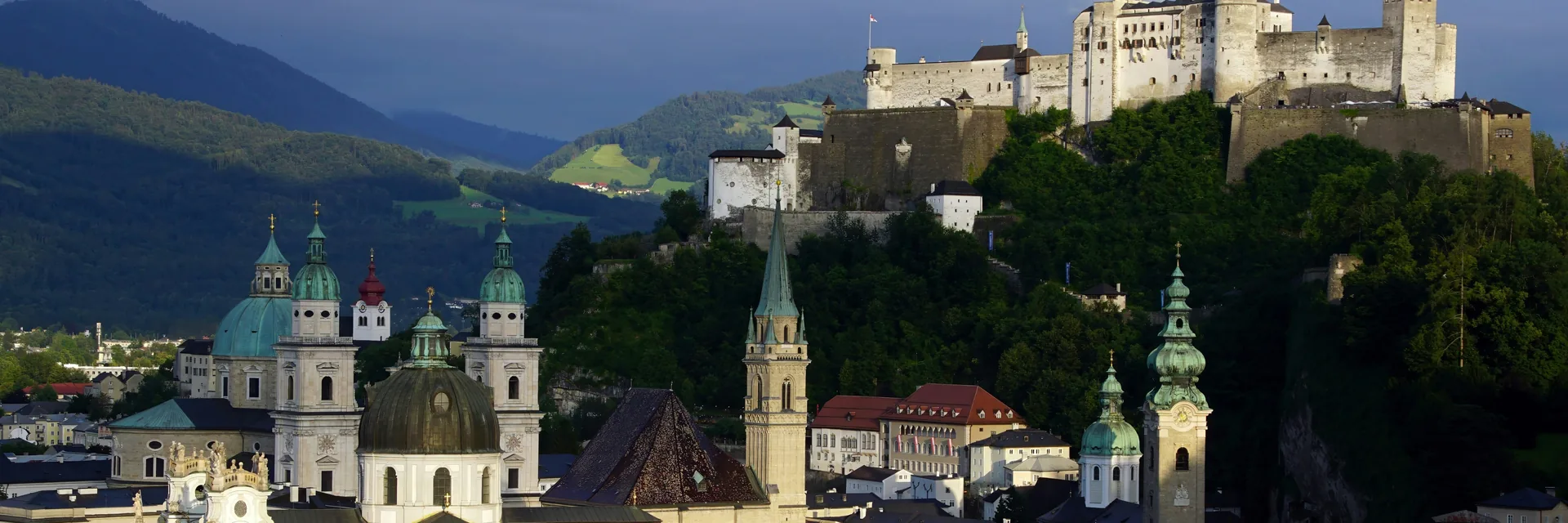
The Golden Hall, the Princes' Chambers, the Salzburg Bull organ in the Krautturm, and museums covering the Rainer infantry regiment, the fortress's own history and marionettes. The Reckturm, the highest point of the fortress, looks out over the old town towards the Alps.
The climb, station by station
Whichever way you go up — funicular or footpath — the route passes the same landmarks on the way to the top.
-
Kapitelplatz
Where the climb starts
Behind Salzburg Cathedral, Kapitelplatz leads onto Festungsgasse, where the funicular's valley station stands and the footpath begins.
-
Hasengrabenbastei
Where the funicular arrives
The funicular climbs to the Hasengrabenbastei, one of the bastions built under Archbishop Paris von Lodron during the Thirty Years' War — the first stop inside the walls.
-
Rosspforte and Schleuderpforte
Keutschach's gates
Two of the gates dated to Leonhard von Keutschach's time (1495–1519), still marking the route from the outer defences into the inner fortress.
-
The Krautturm
Home of the Salzburg Bull
One of four towers added to the ring wall in 1462, the Krautturm holds the Salzburg Bull — a mechanical organ of more than two hundred pipes, first built in 1502.
-
The inner wards
Golden Hall and Princes' Chambers
The state rooms Keutschach fitted out from 1498: the Golden Hall, with its coffered ceiling studded with gilded buttons, and the Golden Chamber and bedchamber beside it.
-
The Reckturm
The top of the climb
The Reckturm is the highest point of the fortress, with views across the old town's domes towards the Alps.
The funicular runs about every ten minutes; allow closer to thirty for the footpath, cobbles and steps included.
Guides
Getting there
How to get to Hohensalzburg Fortress
The funicular takes a minute. The footpath takes thirty. Here's what each one actually involves.
Read the guide →History
Hohensalzburg Fortress: a short history
From a wooden bailey in 1077 to the walls you see today — centuries of building, one failed siege, and a surrender without a fight.
Read the guide →Timing
The best time to visit Hohensalzburg Fortress
Same walls, a very different crowd depending on the hour and the season.
Read the guide →Inside the walls
What to see inside Hohensalzburg Fortress
State rooms, a five-hundred-year-old mechanical organ, and the fortress's highest tower.
Read the guide →Funicular or footpath
Hohensalzburg funicular vs walking path
One costs a minute, the other costs thirty — here's what you actually trade.
Read the guide →Inside the state rooms
The Golden Chamber and Princes' Chambers at Hohensalzburg
The late-Gothic princes' rooms that Leonhard von Keutschach fitted out on the fortress's upper floor.
Read the guide →The Salzburg Bull
The Salzburg Bull: Hohensalzburg's mechanical organ
A five-hundred-year-old mechanical organ with more than two hundred pipes, named for the sound it makes.
Read the guide →Planning the day
Hohensalzburg and the old town: a day itinerary
The fortress is a half-day on its own — here's how it fits around the rest of Salzburg's old town.
Read the guide →Questions people actually ask
Is Hohensalzburg Fortress worth the funicular ride?
Yes — the ride, up the steep face of the Festungsberg in under a minute, is part of what people remember about the visit, and the funicular has run since 1892. The alternative is a thirty-minute uphill walk on cobbles and steps, steeper than it looks from the old town.
How long does a visit take?
Two to three hours for the Golden Hall, the Princes' Chambers, the Salzburg Bull and a walk around the ramparts without rushing. Add ten to fifteen minutes each way if you take the funicular, including the wait at busier times.
What's the difference between the funicular and walking up?
The funicular takes under a minute and runs about every ten minutes from Festungsgasse; the footpath climbs the same hill in about thirty minutes on steep cobbles and steps, and the fortress describes it as not barrier-free. The funicular is the easier option with children, a stroller or limited mobility.
Has Hohensalzburg Fortress ever fallen?
Not by force. It withstood a siege during the German Peasants' War in 1525 — the only siege it faced — and in 1800 it was surrendered to French forces under General Moreau without a fight.
What is the Salzburg Bull?
A mechanical organ of more than two hundred pipes in the Krautturm, one of four towers added to the fortress in 1462. It was built in 1502 for Archbishop Leonhard von Keutschach and renewed in the eighteenth century, and it is named for its loud chord, said to sound like a bellowing bull.
When is the quietest time to visit?
The first hour after opening. The funicular queue and the crowds inside the fortress build from mid-morning, especially in July and August.
Is the fortress open all year?
Yes — the fortress states it is open 365 days a year, with longer hours from May to September and special hours at Easter, in Advent and on December 24th. The funicular closes for scheduled maintenance some weeks of the year, and during some of those closures the museums and indoor areas close too; the fortress's own site lists current hours and dates.
Is there an evening event inside the fortress?
Separately from a daytime visit, Viator lists a dinner-and-concert evening held inside the fortress's historic halls and built around Mozart's music — a different experience from the day visit, run after the museums close.
- Facts checked against the operator Access details and history cross-checked with the fortress's own site and Wikipedia
- Secure checkout on Viator Payment and booking details stay on Viator's own payment system
- No markup added here The price shown is Viator's own; Viator pays us a commission, which doesn't change what you pay
- Independent of the fortress We research and write the guide; we don't run the fortress or issue its tickets
Fortress evenings on Viator
The Festungsbahn funicular carries up to 55 passengers a trip, about every ten minutes, so at busy summer times the wait for the funicular tends to be the slowest part of the visit.
Check dates on Viator ↗